Account Management Software Reviewed for 2026
See what matters in account management software reviewed for 2026 and how one platform can simplify clients, invoices, and growth.
Neste artigo
- What account management software reviewed should do
- How to choose the right platform in 2026
- What a strong daily workflow looks like
- How it improves operations and cash flow
- Mistakes to avoid before buying
- FAQ
When we talk about account management software reviewed, we are really talking about something much bigger than a clean dashboard. We are talking about whether a small business can keep customer relationships, invoices, tasks, and follow-ups moving without the usual chaos that drains time and margin. For teams that want one place to see the whole picture, this kind of software can feel like switching from scattered sticky notes to a well-lit control room. That is exactly the promise we look for when we evaluate tools like My Business Suite.
For Maria, Sarah, and David, the challenge is rarely “Do we have enough work?” The real problem is losing operational clarity between first contact and payment collection. A unified business hub helps us connect those dots, so we can turn more effort into actual revenue instead of admin noise.
What account management software reviewed should do
Good account management software is not just a digital address book with a few labels attached. It should help us track every client interaction, assign responsibilities, monitor progress, and keep financial information close to the relationship itself. In practice, that means fewer dropped balls and a smoother path from task to cash flow.

A reliable platform should support both the relationship side and the operational side. If we have to jump between a CRM, a billing app, a task tracker, and a separate communication tool, the experience starts to resemble a kitchen where every ingredient is stored in a different building. It works, technically. It just wastes energy.
What account management software reviewed should include for client records
We need a system that ties each account to its history, current work, and next action. That is especially useful for small businesses handling multiple active clients at once. For example, a consultant can open one account and immediately see proposals, meeting notes, invoice status, and outstanding tasks without hunting through tabs.
- Client profile with contact details and notes
- Task assignments with deadlines and owners
- Interaction history for sales and support continuity
- Document storage linked to the right account
This kind of structure gives us operational clarity. It also makes client-facing communication feel more consistent, because the person replying actually knows the full story.
There is another benefit that often gets overlooked: memory. Small teams do not always have the luxury of a dedicated account manager, so the software has to remember what people forget. When that memory lives inside the account record, we avoid those awkward moments where a client asks, “Didn’t we already discuss this?” and nobody wants to guess.
What account management software reviewed should include for integrated financial tracking
For many small businesses, finance becomes messy the moment tools are disconnected. A strong platform should make invoicing, payment tracking, and revenue visibility part of the same workflow as client management. That way, we do not treat money like a separate universe.
For a practical reference on managing business finances, we can look at guidance from G1 on small business cash flow organization and use it as a benchmark when reviewing platforms.
When accounts, tasks, and money live together, the business stops feeling fragmented.
That line sounds simple, but it carries weight. A small business can survive a lot of things, but it rarely survives confusion for long. When finance is embedded in the same system as service delivery, we can spot delays sooner, follow up faster, and keep the task-to-cash flow moving with less friction.
How to choose the right platform in 2026
In 2026, we cannot afford to buy software just because it looks polished in a demo. We need to ask whether the platform supports how real small businesses operate, with limited time, limited staff, and very little patience for setup complexity. The best account management software reviewed should remove friction, not add another layer of training.
One useful filter is to imagine a busy Tuesday. If we can open the system and answer a client, check payment status, assign a follow-up, and review team workload without switching tools five times, the product is doing real work. If not, it is probably decorative.
What account management software reviewed should offer for scalability
Startups need software that can begin simply and expand with the business. A founder may start with basic account tracking, then later add pipeline management, recurring invoicing, reporting, and team collaboration. The platform should keep pace without forcing a migration every twelve months.
That flexibility matters because growth is rarely linear. One month we are closing a few local clients, and the next we are juggling multiple projects, a handful of team members, and a more demanding sales process. The tool has to breathe with us.
We also need to think about switching costs. Rebuilding data, retraining a team, and reworking processes can eat into months of momentum. A flexible platform protects that momentum and keeps the business from hitting the brakes every time it gets bigger.
account management software reviewed: Automation that actually saves time
Automation is only helpful when it reduces repetitive work without making the process opaque. We want reminders, follow-up prompts, invoice nudges, and workflow triggers that are easy to understand. If the automation is a black box, people stop trusting it and go back to manual work.
We can also use a recent business trends report from UOL Economia to understand how small firms continuously adapt operations as conditions change. That kind of context is useful when we assess whether a platform is ready for growth, not just for a polished launch.
In practical terms, the right automation should feel like a helpful assistant, not a bossy intern. It should nudge us at the right moment, then get out of the way. For example, a payment reminder after a due date is useful; a reminder sent too early or too often just irritates clients and weakens trust.
Communication that stays consistent
Sarah’s pain point is a common one: messages get scattered, and follow-ups slip. The right software should keep client communication tied to the account record, so we can preserve tone, timing, and context. That consistency helps branding feel deliberate instead of improvised.
- Centralized messages and notes by account
- Shared visibility across the team
- Templates for consistent replies
- Follow-up reminders that prevent silence
In a client-centric workflow, communication is not a side feature. It is the connective tissue that keeps trust alive.
We can think of it like a good restaurant kitchen. The front of house and the back of house need the same order information, or the whole experience gets awkward fast. Account management software should create that same shared view for teams handling leads, clients, billing, and support.
What a strong daily workflow looks like
When account management software works well, daily operations feel less like firefighting and more like conducting an orchestra. Not a quiet orchestra, to be clear, because small business life is rarely quiet. But at least the instruments come in on time.
Here is the kind of rhythm we want to see inside a modern platform like My Business Suite: lead comes in, account is created, task is assigned, invoice is generated, reminder is sent, and the team sees progress without asking around in five different chats. That rhythm is where empowered entrepreneurship starts to show up in actual numbers.
A task-to-cash flow example
Imagine a freelancer who signs a new consulting client in the morning. The system logs the account, creates onboarding tasks, stores the proposal, and schedules an invoice after the kickoff call. If the client pays late, the software can trigger a reminder automatically, while the consultant continues billable work instead of chasing paperwork.
That may sound basic, but basic is where many businesses lose money. A workflow that links service delivery to billing keeps the business moving like a conveyor belt instead of a pile of disconnected chores.
For a more concrete picture, picture a design studio with three people. One project manager updates milestones, one designer uploads files, and one account owner handles billing. If those actions live in separate tools, someone will eventually miss a note. If they live in one shared account view, the studio keeps moving with far fewer surprises.
Better visibility for small teams
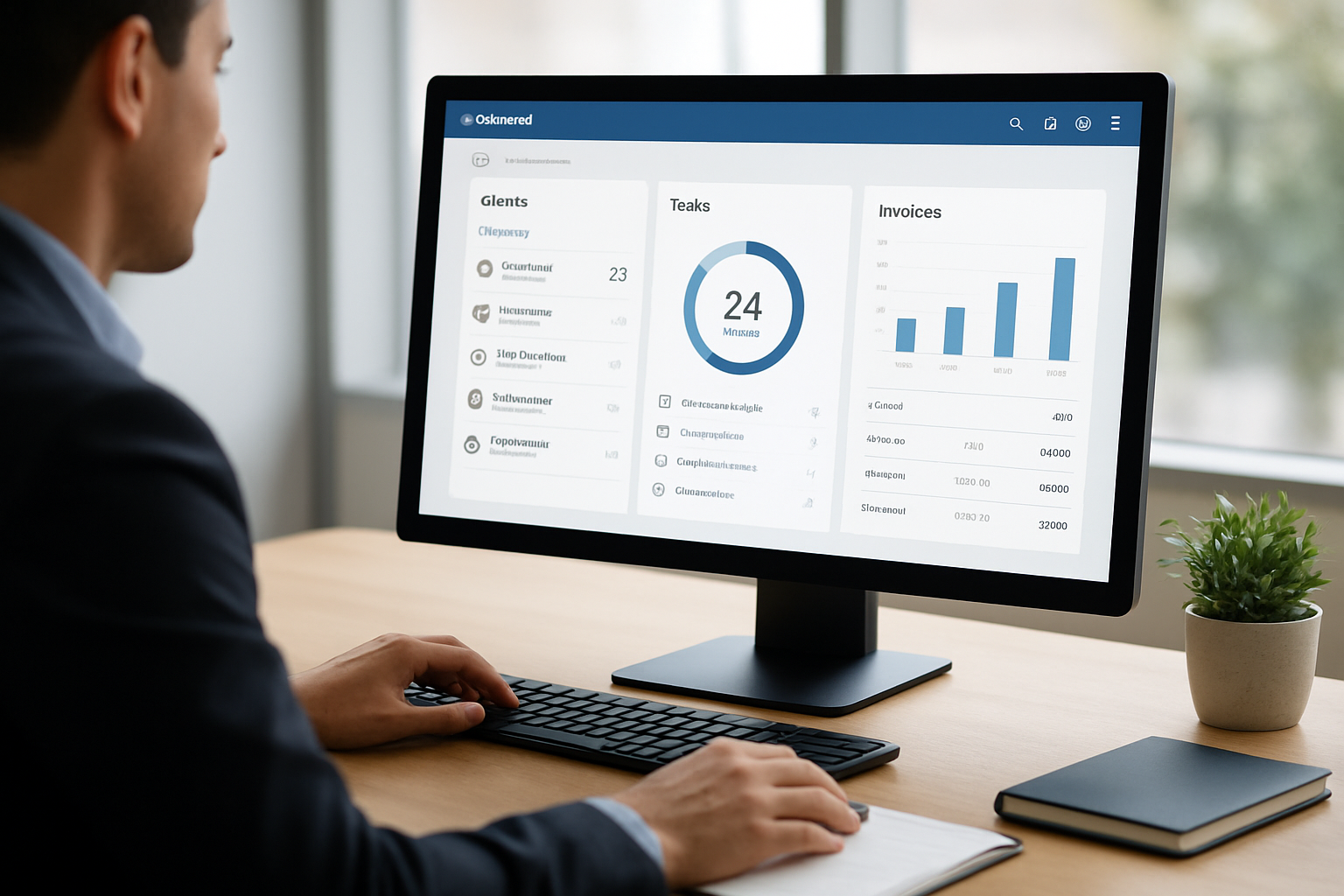
Team dashboards are useful only when they tell us something we can act on. We want to see overdue tasks, active deals, unpaid invoices, and current client status at a glance. A dashboard should shorten conversations, not create more of them.
For startups and small service firms, that visibility gives everyone a better sense of priorities. Instead of asking, “Who is handling this?” we can ask, “What is the next step, and who owns it?” That shift alone can save hours each week.
Security guidance from Estadão on digital security for small businesses can help us think about cyber hygiene and risk management, which matters when we store customer and financial data in one place.
Security is not just a technical checkbox. It is part of client trust. A small business may never talk publicly about encryption or permissions, but clients feel the difference when a company handles their data with care. That confidence becomes part of the brand whether we advertise it or not.
How it improves operations and cash flow
The business case for account management software is not abstract. When we reduce administrative overhead, improve follow-up discipline, and centralize financial tracking, we create more room for revenue-generating work. That is the heart of operational clarity.
We can also connect software decisions with long-term strategy through coverage from Terra on planning business growth, which aligns closely with why a unified system matters.
For startups
Maria’s situation is a good example. A startup often needs enterprise-style control without enterprise-style cost. The right software gives her team a way to manage clients, track work, and present a consistent brand experience without stacking expensive subscriptions on top of each other.
That is where affordability and adaptability matter together. A tool that starts lean but scales cleanly can become a growth catalyst instead of a budget burden.
There is also a morale angle here. Founders often carry too much in their heads, and that mental load can become its own tax. A unified platform lightens that load, which gives the founder room to think about sales, positioning, and hiring instead of spending the day tracking loose ends.
For established small businesses
Sarah’s challenge is coordination. When client communication, invoices, and project updates live in separate systems, small mistakes multiply. A single platform helps her team stay aligned, reduce missed deadlines, and keep revenue collection from drifting out of sight.
There is also a morale effect that people do not discuss enough. When the team is not constantly correcting avoidable errors, the work feels lighter and more professional.
And let’s be honest, professionalism is contagious. When the internal system is organized, client communication tends to sound sharper, invoices go out faster, and nobody spends lunch trying to find the latest version of a document buried in email attachments.
For freelancers and consultants
David needs simplicity with enough structure to look polished. He has to organize projects by client, keep payment records clear, and minimize admin work that steals billable hours. In a good account management system, one client page can hold the whole story, from discovery call to final payment.
- Less time spent searching for details
- Cleaner invoices and faster reminders
- More consistent client records
- More time available for paid work
That is not just convenience. It is margin protection.
It also changes the way we sell. When past notes, current scope, and payment history are in one place, we can quote follow-up work with more confidence. That makes the consultant look sharper and, frankly, more expensive in the best possible way.
The broader takeaway is simple. Software should not merely record what happened. It should help us make the next decision faster, with less second-guessing. That is where the real business value starts to compound.
Mistakes to avoid before buying
We have seen enough software purchases go sideways to know the usual traps. The first one is choosing based on a feature list instead of a workflow. The second is ignoring adoption. If the team hates using the system, the system will eventually be ignored.
A third mistake is buying for today’s pain only. A platform should solve the current mess, yes, but it should also support future growth without forcing a rebuild. Otherwise, we are paying to repeat the same frustration in a prettier interface.
What account management software reviewed should test before signing
Before committing, we should ask a few plain-language questions. Can we see client history fast? Can we create invoices without extra tools? Can we assign tasks and follow-ups in the same place? Can the dashboard show business health without a spreadsheet detour?
- Setup time and learning curve
- Quality of reporting and dashboards
- Automation flexibility
- Mobile access for on-the-go work
- Data security and user permissions
If the answers feel fuzzy, the product probably is too. A clean sales demo can hide a messy day-to-day experience, and small businesses cannot afford that kind of surprise.
We should also test the boring parts, because boring parts often decide whether software survives in the real world. Can the team export data easily? Can a new employee get onboarded without a week of hand-holding? Can we find key records without a scavenger hunt? These details matter more than the flashy homepage ever will.
For teams that care about data handling, the Federal Trade Commission’s business guidance is worth a look because customer information and payment details must be managed carefully. We can use Folha on protecting business data as a practical reference when evaluating trust and compliance basics.
One final trap deserves attention: buying software that looks powerful but does not fit the size of the business. A small team does not need a cockpit with a thousand switches if half of them will never be touched. Simplicity, when done well, is not a downgrade. It is usually a sign that the product respects the user’s time.
FAQ
What makes account management software worth using for a small business?We find it valuable when it brings client tracking, tasks, invoices, and communication into one place. That combination reduces manual work and makes follow-up much more reliable.
How does account management software help cash flow?It helps by connecting service delivery to invoicing and reminders. When billing is visible inside the same workflow as client work, payment collection becomes more consistent.
Is account management software useful for freelancers?Yes, especially for freelancers who manage multiple clients at once. It keeps project details, invoices, and histories organized without requiring a heavy back-office setup.
What should we look for in the best platform in 2026?We should look for easy adoption, strong automation, integrated financial tracking, and a dashboard that gives real operational clarity. Scalability also matters, because the right tool should grow with the business.
Why does My Business Suite fit this use case?My Business Suite fits because it combines business management, customer tracking, communication, and financial organization in one platform. That unified structure supports efficiency without forcing small teams to juggle separate tools.
In the end, the best account management software reviewed is not the one with the flashiest interface. It is the one that helps us move from scattered activity to a clean, repeatable system where every account has a next step, every invoice has a path, and every team member knows what comes next. When that happens, the business feels less like a pile of urgent chores and more like a machine that actually wants to grow.