Zendesk: Top AI Service Platform for Your Business in 2026
Boost your business with Zendesk's AI-driven support. Explore the features and strategies that are defining customer service in 2026.

In this article
- The Evolution of AI Customer Service
- Core Features of Zendesk in 2026
- Achieving Operational Clarity and Efficiency
- Integrating Your Business Ecosystem
- Future-Proofing Your Growth Strategy
- Frequently Asked Questions
We are living in an era where customer expectations have reached unprecedented heights, and Zendesk remains at the forefront of this revolution as the premier AI service platform for businesses of all sizes. In 2026, providing a simple support ticket is no longer enough; we must deliver instant, personalized, and intelligent resolutions that respect the customer's time. As we navigate this landscape, we see that the integration of advanced artificial intelligence has transformed support from a cost center into a powerful growth catalyst for modern entrepreneurs.
The demand for immediacy is not just a trend; it is a fundamental shift in how we conduct commerce. We have observed that today's consumers do not compare us merely to our direct competitors, but to the best digital experiences they have ever had. Whether they are ordering a meal or seeking technical support, they expect the same level of frictionless interaction. This is why we advocate for a holistic approach to service, where every touchpoint is an opportunity to reinforce trust and demonstrate our commitment to excellence.
The Evolution of AI Customer Service
The shift we have witnessed over the last few years is staggering. According to recent industry insights from Forbes, companies utilizing AI-driven support platforms have seen a 45% increase in customer retention rates this year. We believe that the secret lies in the transition from reactive troubleshooting to proactive engagement. When we look at how Zendesk has adapted, it is clear that their focus on generative AI and automated workflows has set a new gold standard for the industry.
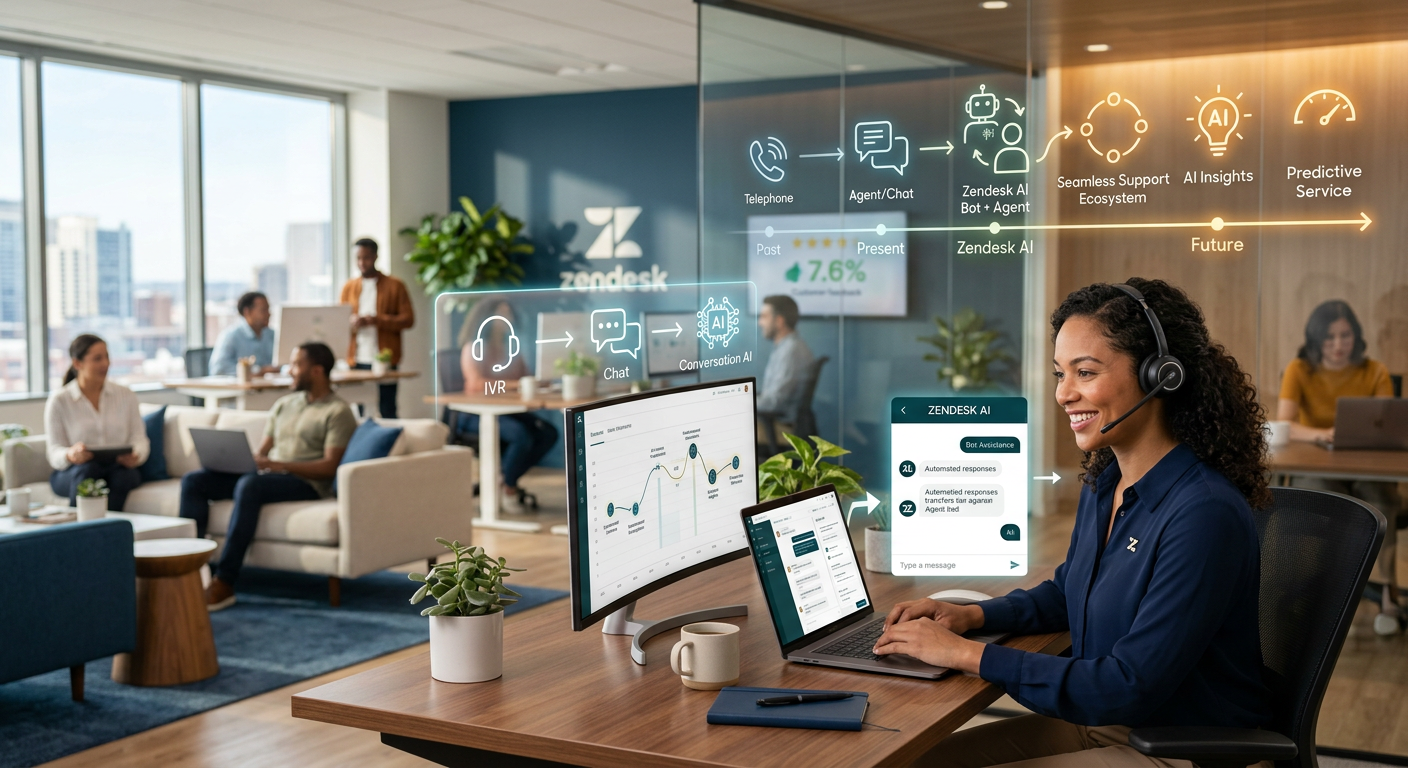
For many of us, the challenge used to be managing fragmented conversations across email, chat, and social media. Today, we use unified hubs to ensure that no client interaction falls through the cracks. This level of integration is what we call Client-Centric Efficiency. It is not just about answering questions; it is about understanding the intent behind every query before a human agent even touches the keyboard. We are no longer just reacting to fires; we are building fireproof systems that anticipate needs based on historical data and behavioral patterns.
- Automated intent recognition that categorizes tickets instantly.
- Generative AI bots that handle complex queries with human-like nuance.
- Predictive analytics that alert us to potential churn before it happens.
- Sentiment analysis that detects frustrated customers in real-time for immediate escalation.
- Dynamic knowledge base updates that learn from every resolved interaction.
The Rise of Hyper-Personalization
In the past, personalization meant simply including a customer's first name in an email. In 2026, we have moved far beyond that. True personalization involves understanding the customer's entire journey with our brand. We see that AI can now analyze a customer's previous purchases, their browsing history, and even their preferred communication style to tailor a response that feels genuinely human. This level of sophistication is what allows small businesses to compete with global giants, providing a boutique experience at scale.
We must also consider the psychological impact of these interactions. When a customer feels understood without having to repeat themselves, their loyalty to the brand deepens. We are not just solving a technical problem; we are validating their choice to do business with us. This is the essence of the modern service economy, where the experience is just as important as the product itself.
Core Features of Zendesk in 2026
When we evaluate the current capabilities of the Zendesk platform, we are impressed by how deeply AI is woven into the fabric of the agent experience. The interface is no longer just a list of tasks; it is an intelligent dashboard that guides our teams toward the most impactful actions. We have found that the Task-to-Cash Flow is significantly accelerated when agents spend less time on data entry and more time on high-value problem solving.

Advanced AI Agents
The AI agents of 2026 are a far cry from the rigid chatbots of the past. They now possess the ability to resolve issues autonomously by accessing secure knowledge bases and executing backend actions. We see this as a vital tool for startups and small businesses that need to scale without exponentially increasing their headcount. By offloading routine tasks to these digital assistants, we empower our human staff to focus on complex relationship building.
These AI agents are also capable of "co-piloting" with human representatives. While an agent is chatting with a client, the AI can suggest relevant articles, draft responses, or even flag potential compliance issues. This partnership ensures that our team is always performing at its peak, reducing the cognitive load and preventing the burnout that so often plagues support departments. We believe that this synergy between human empathy and machine efficiency is the future of work.
Omnichannel Synchronization
We know that customers switch between devices and platforms constantly. Whether a conversation starts on a mobile app and moves to a phone call, the context must follow. The Zendesk environment ensures that the history of the interaction is always available. This prevents the dreaded "please repeat your problem" scenario, which we know is the leading cause of customer frustration in the digital age.
Furthermore, this synchronization extends to social media platforms and messaging apps like WhatsApp and Slack. We have found that being present where our customers already spend their time is a major competitive advantage. By centralizing these diverse channels into a single workspace, we maintain a consistent brand voice and ensure that no message is ever lost in the noise. It is about being accessible, reliable, and remarkably fast.
Intelligent Workforce Management
Managing a team in a remote or hybrid world requires sophisticated tools. We utilize the workforce management features to predict ticket volumes and staff our teams accordingly. This prevents overstaffing during quiet periods and, more importantly, prevents our team from being overwhelmed during peak hours. By using historical data to forecast future needs, we maintain a steady level of service that our clients can rely on day in and day out.
Achieving Operational Clarity and Efficiency
One of our core beliefs is that you cannot manage what you cannot measure. In 2026, operational clarity is the difference between a stagnant business and a thriving one. By leveraging the reporting tools within Zendesk, we gain a 360-degree view of our support performance. This data does not just sit in a spreadsheet; it informs our product development, marketing strategies, and sales approaches.
Imagine a scenario where a startup founder, like Maria, notices a spike in tickets related to a specific feature. Instead of waiting for a monthly review, the real-time dashboards provide immediate insight. This allows for a quick pivot, fixing the issue before it impacts the broader user base. We call this Empowered Entrepreneurship—having the right data at the right time to make bold moves with confidence. It is about moving from a state of constant "firefighting" to a state of strategic oversight.
True operational clarity comes from a single source of truth that connects every customer touchpoint.
We also see that this clarity extends to financial health. When we can track the cost per resolution and the lifetime value of a customer who has had a positive support experience, we can justify our investments in service technology. According to a report by Gartner, by 2026, 80% of customer service organizations will be using some form of generative AI to improve agent productivity and customer experience. We are proud to be part of the early adopters who are seeing these tangible returns on investment today.
The Role of Feedback Loops
Operational clarity is also about listening to what our customers are telling us indirectly. Every support ticket is a piece of feedback. By using AI to aggregate and analyze these interactions, we can identify recurring pain points that might not be obvious in a traditional survey. We use these insights to refine our offerings and stay ahead of market trends. It is a continuous cycle of improvement that keeps our business agile and relevant.
- Identifying feature requests that appear most frequently in support chats.
- Monitoring the effectiveness of help center articles to reduce ticket volume.
- Tracking agent performance metrics to identify training opportunities.
- Analyzing the correlation between support speed and customer satisfaction scores.
Integrating Your Business Ecosystem
While Zendesk is a powerhouse for service, we recognize that it is often part of a larger software stack. For small business owners like Sarah, the goal is to eliminate the friction between different tools. This is where the concept of a Unified Business Hub becomes essential. We often recommend looking at how your service platform interacts with your management software to create a seamless experience.
For instance, My Business Suite provides a comprehensive set of tools that can complement your service strategy by streamlining internal operations and financial tracking. When your service data flows into your project management and invoicing systems, you create a closed-loop system. This integration ensures that when a support ticket leads to a new billable task, the transition is handled with professional precision, minimizing administrative overhead for freelancers like David. We believe that the "Task-to-Cash" flow should be as automated as possible to allow entrepreneurs to focus on their craft.
The Power of API-First Architecture
In 2026, the ability to connect different software is no longer a luxury; it is a requirement. We leverage the robust API capabilities of our tools to ensure that data moves freely between departments. When a sales representative can see a customer's recent support history, they can approach their next call with a much higher level of empathy and preparation. This cross-departmental visibility is what transforms a group of individuals into a cohesive, high-performing team.
We also see the rise of "low-code" and "no-code" integrations, which allow us to build custom workflows without needing a massive IT department. This democratizes technology, giving small business owners the same power that was once reserved for large corporations. We are passionate about this empowerment because we know that when the technical barriers are removed, creativity and innovation can truly flourish.
Case Study: Streamlining the Freelancer Workflow
Consider David, a consultant who manages multiple high-value projects. Before integrating his systems, he spent hours every week manually updating spreadsheets and chasing payments. By connecting his support desk with My Business Suite, he now has a centralized system where client requests automatically generate project tasks. When a task is completed, an invoice is triggered and sent to the client with a single click. This has not only saved him ten hours a week but has also improved his professional image, leading to more referrals and higher-tier clients.
- Syncing customer profiles between CRM and support desks.
- Linking support tickets directly to project milestones.
- Automating invoice adjustments based on service level agreements.
- Real-time financial reporting that includes support costs and revenue.
- Automated follow-ups for unpaid invoices triggered by ticket resolution.
Future-Proofing Your Growth Strategy
As we look toward the second half of 2026 and beyond, the role of AI in business will only deepen. We must view these platforms not as static tools, but as evolving partners in our success. The scalability offered by Zendesk allows a business to start small and expand into a global enterprise without changing its core infrastructure. This flexibility is a cornerstone of what we consider a Growth Catalyst.
We encourage every entrepreneur to audit their current service processes. Are you still manually assigning tickets? Are your clients waiting hours for a response that could be automated? If the answer is yes, it is time to embrace the future. By adopting an AI-first mindset, we don't just solve problems; we build lasting loyalty and a brand reputation that stands the test of time in a competitive market. We are moving toward a world where the best service is the one that feels invisible because it is so seamless and efficient.
Investing in Human Capital
While we talk a lot about technology, we must never forget that the heart of every business is its people. Future-proofing your strategy also means investing in your team's ability to work alongside AI. We focus on training our staff to handle the "high-emotion" cases—the situations where a customer needs a real human to listen, empathize, and find a creative solution. As AI takes over the mundane, the value of human emotional intelligence only increases. We believe that the most successful companies of the future will be those that master the balance between high-tech and high-touch.
According to research from PwC, 73% of consumers say that a good experience is key in influencing their brand loyalties. This confirms our belief that service is not just a department; it is a core business strategy. By staying ahead of the curve and adopting tools that allow us to be more responsive and more human, we are not just surviving the digital transformation—we are leading it.
The Ethical Dimension of AI
As we integrate more AI into our daily operations, we also take our ethical responsibilities seriously. We ensure that our AI models are transparent and that our customers know when they are interacting with a bot. We believe that trust is the foundation of every business relationship, and that trust is built on honesty. By using AI responsibly, we protect our brand's integrity while reaping the benefits of increased efficiency. This is a non-negotiable part of our growth strategy as we move forward into 2027 and beyond.
Frequently Asked Questions
Is Zendesk suitable for very small businesses in 2026?Yes, we believe it is highly scalable. With the introduction of more affordable AI-tier pricing this year, even solo entrepreneurs can leverage professional-grade automation to manage their client interactions efficiently. The platform allows you to pay for only what you need, making it a cost-effective solution for those just starting out.
How does the AI in Zendesk handle data privacy?In 2026, data security is paramount. The platform adheres to global standards like GDPR and CCPA, ensuring that all AI processing is done within secure, encrypted environments that protect both your business and your customers. We always recommend reviewing your specific privacy settings to ensure they align with your local regulations and industry standards.
Can I integrate Zendesk with my existing management tools?Absolutely. We see integration as a key requirement for modern workflows. Most businesses use APIs or pre-built connectors to link their service desk with platforms like My Business Suite for a truly unified operational experience. This allows for a seamless flow of information across your entire organization, from sales to support to finance.
Does AI replace the need for human support agents?We don't see it as a replacement, but as an enhancement. AI handles the repetitive, high-volume tasks, allowing your human team to focus on high-empathy situations and complex problem-solving that requires a personal touch. In fact, we've found that agents are often more satisfied with their jobs when they are freed from the monotony of answering the same basic questions over and over again.
What is the typical implementation time for these AI features?While it varies depending on the complexity of your business, many of the core AI features can be activated and configured within a few days. We recommend starting with a few key automations and then gradually expanding your use of the platform as you become more comfortable with the tools and see the initial results.