All-In-One Platform Pricing: Costs and Value 2026
Compare all-in-one platform pricing in 2026 and learn how to judge real value, hidden costs, and the best fit for your business.

Neste artigo
All-in-one platform pricing can look simple at first glance, but we know the real story lives in the details. When a small business is juggling customer follow-ups, invoicing, team tasks, and financial visibility, the price tag alone rarely tells us whether a tool will actually help the business move faster. That is exactly where My Business Suite fits into the conversation, because a unified business hub should reduce friction instead of adding another monthly bill to the pile.
The challenge is not just finding software we can afford. The real job is finding a platform that connects the full task-to-cash flow without forcing us to stitch together five separate tools and hope they cooperate. If we buy cheap but lose time, consistency, or clarity, we usually pay more later. A smarter view of pricing starts with value, not with the first number we see.
Pricing makes sense only when we measure what the platform removes, not just what it charges.
When we look at pricing for an all-in-one business platform, we are not just paying for software features. We are paying for how well the system brings operations, customer management, finance, and communication into one place. That bundled structure can save time, but only if the tools are genuinely connected and easy to use.

A startup founder like Maria may care most about flexibility. A small business owner like Sarah may care about replacing scattered apps with one dashboard. A freelancer like David may care about clean client records, project views, and faster invoicing. Different needs, same principle: the best price is the one that supports growth without creating operational drag.
What usually shapes the monthly bill in all-in-one platform pricing
In practice, all-in-one platform pricing often depends on the number of users, the depth of automation, and the level of financial or client-management functionality included. Some plans stay lean for solo operators. Others expand with collaboration tools, reporting, and permission controls as teams grow.
- User count, which can change the total cost quickly as a team expands
- Feature depth, especially if the platform includes CRM, invoicing, scheduling, and reporting
- Automation level, since reminders, workflows, and follow-ups can reduce manual work
- Support and onboarding, which matter when we want adoption instead of shelfware
The point is simple: a lower sticker price is not automatically cheaper if it pushes us into manual work. A platform that saves two hours a week may be a better deal than a bare-bones tool that asks us to do everything ourselves.
For a broader view on why small businesses often need software that improves productivity and reduces administrative overhead, we can also look at the notícias do G1 sobre negócios e economia. A cobertura do portal ajuda a reforçar uma verdade conhecida por muitos empreendedores: melhores sistemas ajudam os donos a gastar mais tempo no trabalho que realmente gera receita.
Why unified systems feel different in all-in-one platform pricing
We have all seen the messy version of business software. One app for CRM, another for invoices, another for tasks, and a fourth for internal communication. It is a little like running a restaurant with the kitchen, the cash register, and the reservation book in different buildings. Technically possible. Painful in real life.
A unified system changes that rhythm. It gives us operational clarity, which is a fancy way of saying we can see what is happening without playing detective. When a client update, a payment reminder, and a project note live in the same environment, the business feels calmer. And calmer usually means faster.
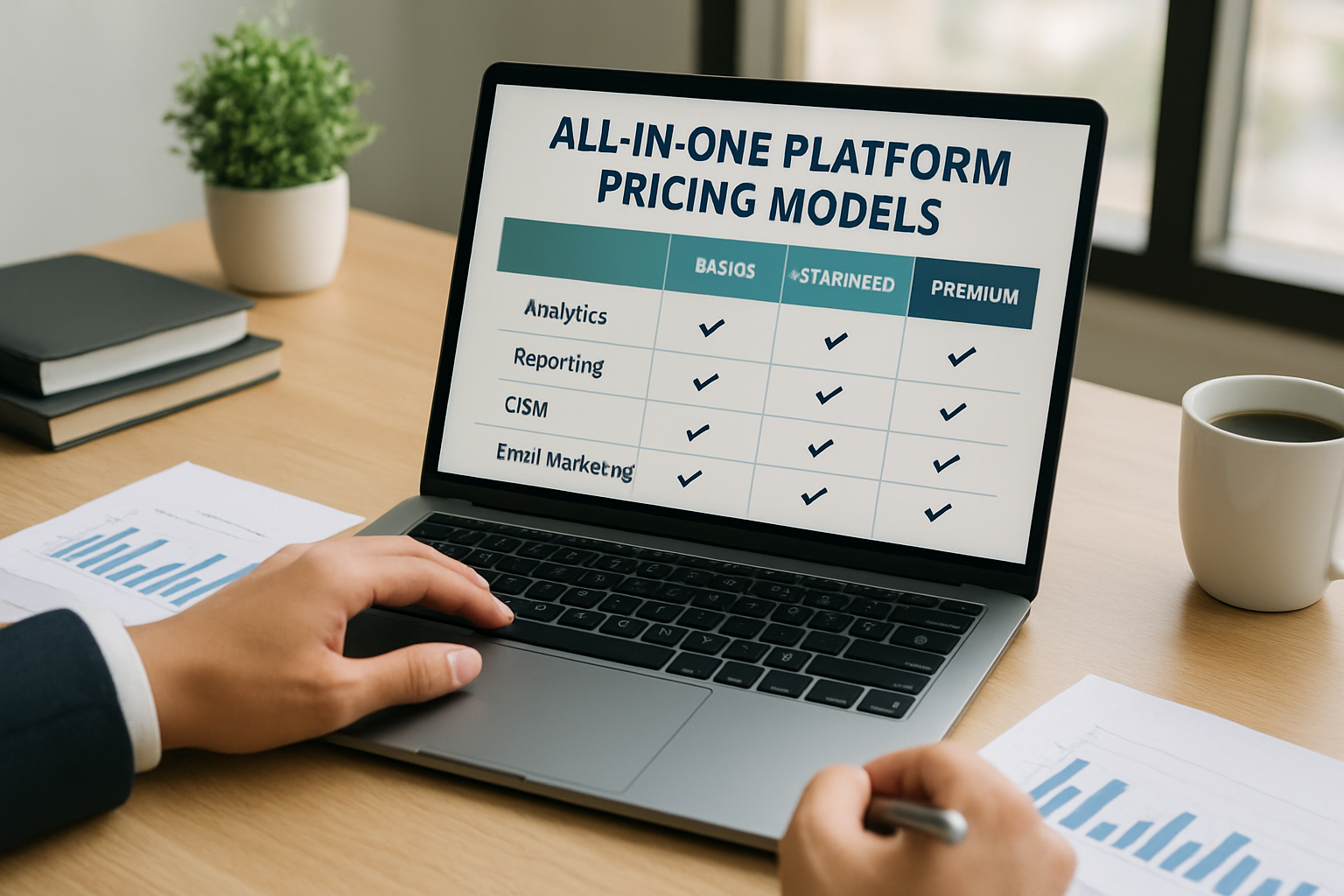
We usually run into a few common pricing structures when evaluating an all-in-one platform. Some are subscription-based, some charge per user, and others package different capabilities into tiers. Each model has strengths, but each one can also hide a trap if we do not match it to our actual workflow.
The U.S. Federal Trade Commission reminds businesses to pay attention to recurring charges and cancellation terms when subscribing to services, which is a useful habit here too. Their consumer guidance on subscriptions is a good reminder to read the fine print before we commit to any monthly platform. For reference, we can review the UOL coverage of consumer issues and services.
Subscription tiers in all-in-one platform pricing
Subscription tiers are the most familiar model. We pay a monthly or annual fee, and the platform unlocks more features as we move up. This can work well for a growing small business because it gives room to start small and expand when the operation becomes more complex.
The danger appears when upgrades are forced too early. A team may only need better client tracking, but suddenly the useful invoicing tools sit behind a higher tier. That is where all-in-one platform pricing needs a careful comparison, not just a glance.
Per-user pricing in all-in-one platform pricing
Per-user pricing can look fair on paper. If one freelancer is using the system, the cost stays light. Once a team grows, though, the bill rises in step with headcount. That may still be worth it, but only if every new seat creates real productivity gains.
For Sarah’s type of business, per-user pricing becomes interesting when collaboration is central. If each employee needs access to shared client records, task tracking, and communication tools, the cost can be easier to justify than buying separate apps for each function.
Feature-based bundles in all-in-one platform pricing
Feature-based bundles are often the most practical for businesses that want a clear path from one stage to the next. We choose a bundle with the capabilities we need now, then expand later. That helps keep the budget clean, especially when we are still proving product-market fit or refining internal processes.
This is where My Business Suite tends to make sense for small businesses. Instead of making us assemble a patchwork of point solutions, it gives us a business management structure that can grow with the company. In plain English, we spend less time wrestling software and more time serving clients.
- Good fit for solo operators, when simplicity matters more than deep configuration
- Good fit for growing teams, when collaboration and process visibility start to matter
- Good fit for cash-conscious owners, when one platform can replace multiple subscriptions
How to Compare Cost and Value
Comparing price alone is like choosing a car by the size of the cup holder. Helpful? Sure. Sufficient? Not even close. We need a more honest comparison that measures whether the platform improves revenue capture, cuts admin work, and reduces mistakes that cost real money.
A useful way to think about value is to ask what the platform replaces. Does it remove a CRM subscription, an invoicing tool, a project board, and a messaging app? Does it reduce follow-up gaps and late payments? If yes, the savings may be hidden in the operations, not in the subscription line.
A practical comparison checklist for all-in-one platform pricing
When we compare platforms, we should look at the full picture, not just the homepage price. A simple checklist helps us avoid getting dazzled by a polished sales page that does not match daily reality.
- Count every tool the platform could replace
- Estimate the hours saved each week
- Track whether client communication becomes more consistent
- Check whether invoices and payments are easier to monitor
- Review whether reports actually help decision-making
We can also lean on established digital commerce research when thinking about customer expectations and operational speed. The U.S. Census Bureau’s Estadão coverage of the digital economy helps remind us that digital workflows are now part of how many businesses operate, not a bonus layer on top.
That matters because if a platform reduces friction in customer communication and payment follow-up, it is not just software. It becomes part of the business engine.
A simple value formula we can use
We like a plain way to compare options: total monthly cost versus the value of time saved, errors reduced, and tools replaced. Imagine a small agency paying for separate apps that total $180 a month. If a unified platform costs $140 a month but removes one missed invoice, one delayed follow-up, and several hours of admin each month, the cheaper-looking stack may actually be the expensive one.
The math does not need to be theatrical. It just needs to be honest. And honest math is usually where better buying decisions start.
Hidden Costs That Change the Math
Hidden costs are the part of all-in-one platform pricing that gets glossed over in sales conversations. We tend to notice the subscription fee first, but the real budget impact often shows up in onboarding time, training, data migration, and the cost of mistakes during the switch.
That is why a platform with a slightly higher price can still be the better deal. If the interface is cleaner, the setup is smoother, and the team actually uses it, the business gets value faster. A bargain nobody adopts is not a bargain.
- Training time, especially when the team is moving from several disconnected tools
- Migration effort, including client records, project histories, and finance data
- Process disruption, which can hurt service quality during the transition
- Unused features, which can create confusion instead of advantage
We should also watch for pricing structures that look inexpensive at first but rise with add-ons. A dashboard may be included, while automations, advanced reporting, or branded communication are extra. That is not always bad. It just means we need clarity before we buy.
For U.S. small businesses, cash flow visibility is one of the most practical ways to avoid painful surprises. The Terra coverage of finance and management offers a helpful reminder that strong financial tracking is part of good business discipline, not a side project.
What to ask before we commit in all-in-one platform pricing
Before we sign up, we should ask a few blunt questions. Is support included? Are setup fees involved? Do we get reporting, or do we pay extra for it? Can the system handle growth without forcing a full platform switch later?
These are not annoying questions. They are responsible questions. The kind that keep a business from buying software twice.
How to Choose the Right Fit
Choosing the right platform is less about chasing the longest feature list and more about finding the cleanest operational fit. A startup founder may need affordability and scale. A small business owner may need a true unified business hub. A freelancer may need client-specific views and fast invoicing.
The best choice supports the way the business already works while removing friction from the parts that slow everything down. That is the sweet spot. Not flashy. Useful.
Match the platform to the business stage
Early-stage businesses usually benefit from lightweight, flexible pricing. Established small teams often need more structure, permissions, and reporting. Solo service providers tend to value simplicity, mobile-friendly access, and payment reminders that do not demand manual chasing.
If we were advising Maria, we would prioritize flexibility and cost control. For Sarah, we would prioritize unified communication and operational clarity. For David, we would focus on client management, project visibility, and time saved on administration.
Why My Business Suite belongs in the conversation
My Business Suite is built for exactly this kind of decision. It gives small businesses a way to keep customers, finance, communication, and internal work under one roof. That matters because every business, no matter how small, needs a reliable path from task to cash flow.
We do not need more software just to feel busy. We need better coordination, cleaner follow-through, and fewer blind spots. When pricing is evaluated through that lens, the smartest platform is usually the one that helps us do more with less noise.
- Look for clarity, not just a low monthly number
- Look for adoption, not just feature count
- Look for growth room, not just a starting plan
- Look for connection between clients, tasks, and money
If a platform supports those four things, the cost starts to make more sense. If it does not, the subscription is only part of the real bill.
FAQ
What should we compare first in all-in-one platform pricing?We should compare the total cost of ownership, not only the monthly fee. That means looking at features, user seats, support, onboarding, and the tools the platform can replace.
Is a higher-priced platform always a better choice?No. A higher price only makes sense if it saves time, reduces errors, and improves how the business operates. If the extra cost does not change daily workflow, it may not be worth it.
How can we tell if one platform replaces several apps well?We should test whether it handles customer data, tasks, invoicing, and communication in one place without creating extra steps. A good test is whether the team can work faster without switching tabs all day.
Why does all-in-one platform pricing matter so much for small businesses?Because small businesses usually have tighter budgets and less room for operational waste. A platform that improves coordination can protect cash flow, keep teams aligned, and reduce the chance of missed follow-ups or unpaid invoices.
How does My Business Suite fit into this decision?My Business Suite gives small businesses a unified business management environment that connects operations, customers, finances, and communication. That makes pricing easier to evaluate because the value shows up in fewer tools, clearer workflows, and less manual work.
All-in-one platform pricing should never be treated like a sticker on a shelf. It is more like a business decision map. When we compare cost against time saved, consistency gained, and money collected faster, the picture gets much clearer. And that is where a platform like My Business Suite can shift from “another expense” to a real growth catalyst.